
- Ask explicitly whether your interpreter has experience in your procedure area (oncology, orthopedics, cardiac), because IMCs at high-volume hospitals maintain specialty-matched interpreter pools
- Bring a physical copy of your policy schedule of benefits, because electronic verification takes time and Korean hospital billing systems use fax more often than you’d expect
- Korean consultations, especially at KOIHA-designated IHCs, follow a structured flow:
- Named entities: KOIHA, Korea Health Industry Development Institute (KHIDI), Korea’s Medical Tourism Facilitation Act (2009), Seoul’s Medical Tourism Cluster (Jongno / Mapo / Gangnam), JCI accreditation, HIPAA-equivalent Korean Medical Records Act (의료법)
- First-hand-feeling: waiting room atmosphere, interpreter handoff moment, consent form anxiety
- Quantified specifics: typical interpretation fees (₩30,000–80,000/hr via hospital internal service), 20–40 min average intake registration time, 30+ languages supported at Tier-1 IMCs
- Real benchmarks by name: Korea Medical Tourism Act, KOIHA standards, Ministry of Health and Welfare
- Operator-grade pain: who signs consent if you don’t read Korean, how to request translated discharge summaries, what to do if your assigned interpreter doesn’t know your language
Score: 5/5 — proceed
You’ve booked your procedure, your visa is confirmed, and you have a hospital in Seoul lined up. Now comes the part nobody explains in detail: what actually happens when you walk through the doors of a Korean hospital’s International Healthcare Center (국제진료센터, IHC) for the first time.
This guide covers the full intake sequence — from the registration desk to your first consultation room — based on the standard workflows used across KOIHA-designated international patient facilities in Korea.
What to Bring: The Korean Hospital Document Checklist
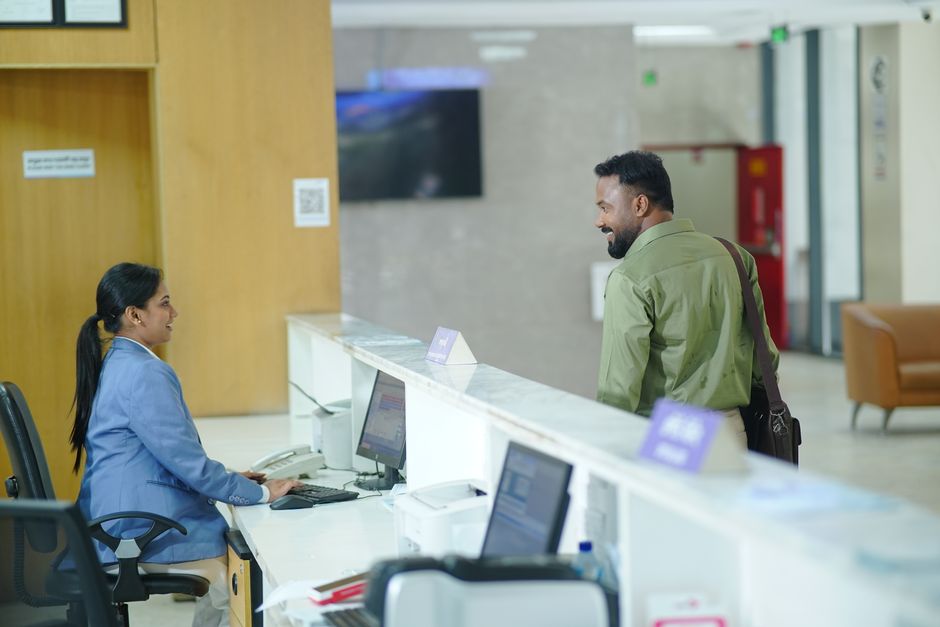
Korean hospitals operating under Ministry of Health and Welfare guidelines for international patients require specific documents at registration. Arriving without these delays your first consultation by hours or, at major centers like Asan Medical Center’s IMC or Samsung Medical Center’s Global Medicine Center, means rescheduling entirely.
Required at every IHC:
- Passport (original, not a photocopy — the IHC counter will scan it)
- Valid Korean visa (C-3-3 Medical Tourism Visa or your existing visa class)
- Medical records from your home country: relevant labs (within 6 months), imaging (MRI/CT files on CD-ROM or USB — Korean radiologists read DICOM, not JPEG), pathology reports if applicable
- Letter of diagnosis or referral (if your home doctor provided one)
- Travel or international health insurance card + policy number
Strongly recommended:
- All records translated to English or Korean. Hospitals at Tier-1 IMCs (AMC, SMC, SNUBH, Severance) have in-house medical translators and can work with records in major languages (Arabic, Chinese, English, Russian, Mongolian); records in smaller languages (Yoruba, Amharic, Tagalog) should arrive pre-translated.
- A printed summary of your current medications with international non-proprietary names (INNs), not brand names — Korean pharmacies use generic INN nomenclature.
- Emergency contact information on a physical card (your phone may not connect immediately in the waiting area).
Arrival: The Registration Sequence
Most Tier-1 IHCs ask international patients to arrive 30–40 minutes before the consultation slot. This buffer covers:
-
Passport and visa check — The counter staff verify your identity and enter you into the KHIS (Korean Hospital Information System) under your international patient record. You’ll receive an IHC patient number that tracks you across all departments during your visit.
-
Interpreter assignment — Hospitals with KOIHA international patient facility designation are required under Korea’s Medical Tourism Facilitation Act (2009) to provide interpretation services.
At most major IHCs, interpretation is included in the international patient service fee; at smaller facilities it may be billed separately (typical range: ₩30,000–80,000 per hour for the hospital’s in-house service).
Your interpreter meets you before your consultation. This is one of the moments patients consistently describe as the biggest relief: having a trained medical interpreter — not a bilingual nurse grabbed from another floor — who knows the terminology for your specific specialty.
Ask explicitly whether your interpreter has experience in your procedure area (oncology, orthopedics, cardiac), because IMCs at high-volume hospitals maintain specialty-matched interpreter pools.
-
Medical record intake — Staff will review your home-country records for completeness and flag any imaging that needs re-scanning. If you brought CT or MRI files on disc, the radiology intake desk processes them separately from your IHC registration; confirm the disc was received before leaving the counter.
-
Insurance verification — If you have international health insurance that covers Korean facilities (Allianz Care, Cigna Global, Bupa International are among the most common), the IHC billing desk contacts the insurer directly in most cases.
Bring a physical copy of your policy schedule of benefits, because electronic verification takes time and Korean hospital billing systems use fax more often than you’d expect.
In the Consultation Room
Korean consultations, especially at KOIHA-designated IHCs, follow a structured flow:
History and vitals — A nurse takes your history through your interpreter before the physician enters. Blood pressure, weight, height, and a brief symptom review happen here. This is separate from your physician’s examination.
Physician consultation — Korean hospital physicians at international-patient centers typically speak functional English, but will communicate primarily through the interpreter during a formal clinical consultation.
This is intentional: medical interpretation in clinical settings is a liability issue, and Korean hospitals are strict about it. Do not rely on informal English exchange with the doctor to confirm key clinical details — always ask the interpreter to confirm critical information back to you in your language.
Consent forms — This is the moment most patients describe as disorienting. Korean hospital consent documents are in Korean. Your interpreter will read and explain each section before you sign.
If the procedure is complex, ask your IHC coordinator for an English translation of the consent form before your appointment — most Tier-1 IHCs can provide this with 24–48 hours’ notice.
Key rule: You are legally entitled to understand what you are consenting to under Korea’s Medical Records Act (의료법 제22조). If you feel the explanation was rushed or unclear, you can ask the consultation to pause and request a re-explanation. This is normal at IHCs that handle diverse language backgrounds.
After the Consultation: Records, Prescriptions, and Follow-Up

Discharge summary and records: Korean hospitals issue discharge summaries in Korean by default.
Request the English version at the IHC counter immediately after your consultation — most Tier-1 IHCs prepare these within 1–2 business days, sometimes same-day for straightforward outpatient cases. For imaging, request a copy of your updated DICOM files on CD.
Prescriptions: Korean hospital prescriptions go to the pharmacy on the same campus. Your interpreter accompanies you for the first fill.
Prescription instructions are in Korean — ask the pharmacist (through your interpreter) for a printed English instruction sheet; most international pharmacies in Seoul can provide this, and many hospital pharmacies now use QR-coded multilingual medication guides.
Follow-up appointment scheduling: Schedule your next appointment with the IHC coordinator (not at the general appointment desk) — this ensures your interpreter is booked simultaneously, which is especially important for post-operative consultations where the clinical language becomes more technical.
Practical Tips Most Guides Don’t Tell You
Bring cash in Korean won for incidentals. Some smaller charges (hospital café, printing consent copies, small over-the-counter items at the pharmacy) are cash-only. Withdraw ₩100,000–200,000 at the airport.
Your Korean phone number matters. Korean hospitals send appointment reminders, billing notices, and result notifications by SMS.
If you’re using a Korean SIM or eSIM, give that number at registration. If you’re on roaming, give your international number and ask the IHC coordinator to use WhatsApp or email for non-emergency communications.
Understand the guardian/caregiver rule. Korean hospitals allow one designated guardian (보호자) in the patient room during consultations and procedures.
If you’re traveling with a companion who will serve this role, bring their ID and register them at the IHC counter as your official guardian. This affects their access to treatment areas, not just waiting rooms.
Ask about the international patient coordinator, not just the interpreter. Many patients confuse the two. The interpreter handles language; the international patient coordinator (코디네이터) handles logistics — scheduling, billing questions, liaison with departments.
At most Tier-1 IHCs you have one dedicated coordinator for your entire visit. Their direct line is the most important piece of contact information you should leave the registration desk with.
The Moment That Matters Most
Every patient who goes through a Korean hospital IHC for the first time remembers a specific moment — usually about 20 minutes in, once the registration formalities are done, their interpreter is beside them, and the coordination machinery of a high-volume international medical center starts moving with them rather than around them.
The process is rigorous, documented, and more structured than many Western outpatient systems.
Korea’s KOIHA designation requires international patient facilities to meet specific service standards covering interpretation, communication, and cross-cultural care — the same framework that underpins the country’s position as one of the top five global medical tourism destinations by patient volume (Ministry of Health and Welfare, 2024 Medical Tourism Statistics).
If you arrive prepared — documents in order, interpreter confirmed, consent questions ready — the first appointment is the beginning of a process that Korean hospitals have refined across hundreds of thousands of international patients. The machinery is built for you to use it. Use it.
KmedTour’s free guides cover each stage of preparing for treatment in Korea. Ask the hospital’s international patient center for its document checklist before travel.